
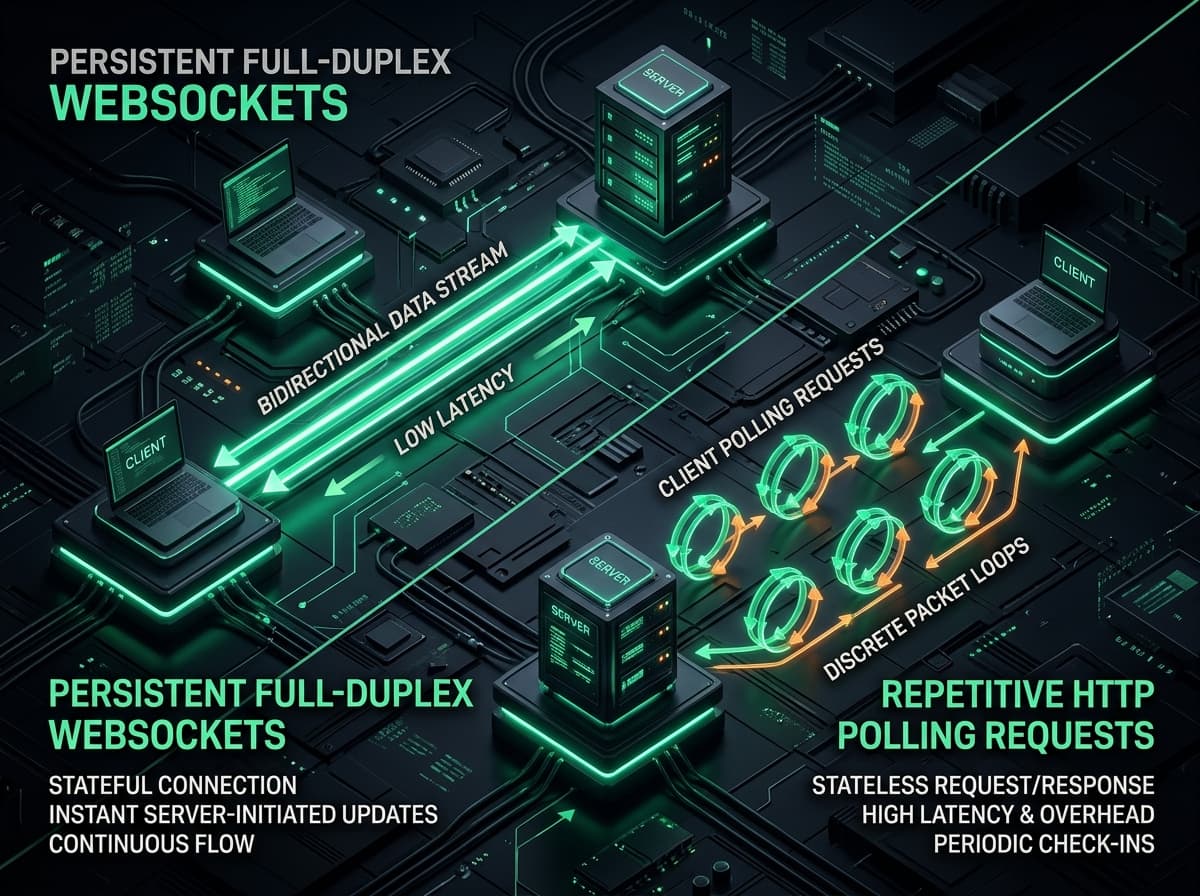
"We need real-time updates" is one of the most common requirements I hear from founders, and it's almost always followed immediately by "so we need WebSockets." Sometimes that's true. Often it isn't, and the simpler option would have shipped faster, cost less to run, and been easier to debug.
What each approach actually does
Polling means your client asks the server for updates on a regular interval, every few seconds, say, whether or not anything's changed. Simple to implement, works with standard HTTP infrastructure, and easy to reason about.
WebSockets open a persistent, two-way connection between client and server. The server can push updates the instant something happens, without the client having to ask. More complex to implement and operate, but genuinely real-time in a way polling can only approximate.
When polling is actually the right call
- Updates that don't need to feel instant. A dashboard showing metrics that update every few minutes doesn't need sub-second latency. Polling every 30-60 seconds is invisible to the user and dramatically simpler to build and maintain.
- Low-frequency, non-critical updates. Notification badges, status checks, anything where a few seconds of lag genuinely doesn't matter to the user experience.
- Early-stage products validating a feature. If you're not yet sure a real-time feature is even something users want, building it with polling first lets you validate the feature without committing to the operational complexity of a WebSocket layer you might rip out later.
- Infrastructure simplicity matters more than instant updates. Polling works through standard load balancers and infrastructure without special configuration. WebSockets often need sticky sessions or specific infrastructure support, which is one more thing to get right.
When WebSockets actually earn their complexity
- Chat, collaborative editing, or anything users expect to feel instant. If a delay is noticeable and annoying, that's the signal WebSockets are solving a real problem, not just a nice-to-have.
- High-frequency updates at scale. If you'd need to poll every second or two to approximate real-time, the bandwidth and server load from constant polling requests often exceeds what a persistent WebSocket connection would cost, at which point WebSockets become the more efficient choice, not just the fancier one.
- Bidirectional communication. If the server needs to push data to the client without a corresponding request, live notifications, presence indicators, collaborative cursors, WebSockets are built for exactly this, and polling can only awkwardly approximate it.
The mistake I see most often
Founders reach for WebSockets because it sounds more technically impressive, then discover months later they've built a feature that needed sticky session handling, reconnection logic, and scaling considerations for a use case that genuinely could have shipped with 30-second polling and nobody would have noticed the difference.
The inverse mistake happens too, though less often: teams try to force genuinely real-time features, like collaborative editing, through aggressive polling, and end up with a worse user experience and higher server load than a properly implemented WebSocket connection would have delivered.
A decision framework
Ask these questions in order:
- Would a user notice a 10-30 second delay? If no, use polling. This resolves most "we need real-time" conversations immediately.
- Does the server need to push data without the client asking first? If yes, that's a genuine WebSocket use case.
- What's your actual update frequency need? If you'd need to poll more than once every 5-10 seconds to feel responsive enough, the efficiency math starts favoring WebSockets.
- Do you have the operational maturity to run and monitor a WebSocket service? This isn't a reason to avoid WebSockets forever, but it's a legitimate factor for a very early-stage team choosing where to spend limited engineering time.
A middle path worth knowing about
Server-Sent Events (SSE) sit between these two options: one-directional server-to-client push, simpler to implement than full WebSockets, but without the two-way communication. If your use case is purely "push updates to the client" without needing the client to send data back over the same connection, SSE is worth evaluating before jumping straight to WebSockets.
What I actually build for clients
Most dashboards and status-update features I build start with polling, because it's genuinely sufficient and ships faster. WebSockets get introduced specifically when a feature's user experience depends on sub-second responsiveness, chat and live collaboration being the clearest examples, not as a default architecture decision made before the requirement actually demands it.
The bottom line
WebSockets aren't the "correct" real-time solution and polling isn't the "lazy" one. They solve different problems at different costs. Match the tool to how real-time your feature actually needs to feel, not to which option sounds more impressive in an architecture diagram.
Suggested internal links: Link to Day 5's Redis caching article and Day 20's scalable SaaS architecture piece.
CTA: Architecting a real-time feature and not sure which way to go? Book a free consult.